
Happy Winter
and happy new year

In the last week of 2025, I wrote about Raymond Briggs’ The Snowman, a decidedly non-Christmas book about solitude and impermanence. The snowman melted, the year ended.
But winter keeps going. After the holidays pass and the decorations start to come down, we’re still left with months of cold ahead, that “bleak midwinter.” January and February are months of endurance, missing the sparkle but with snow still falling.
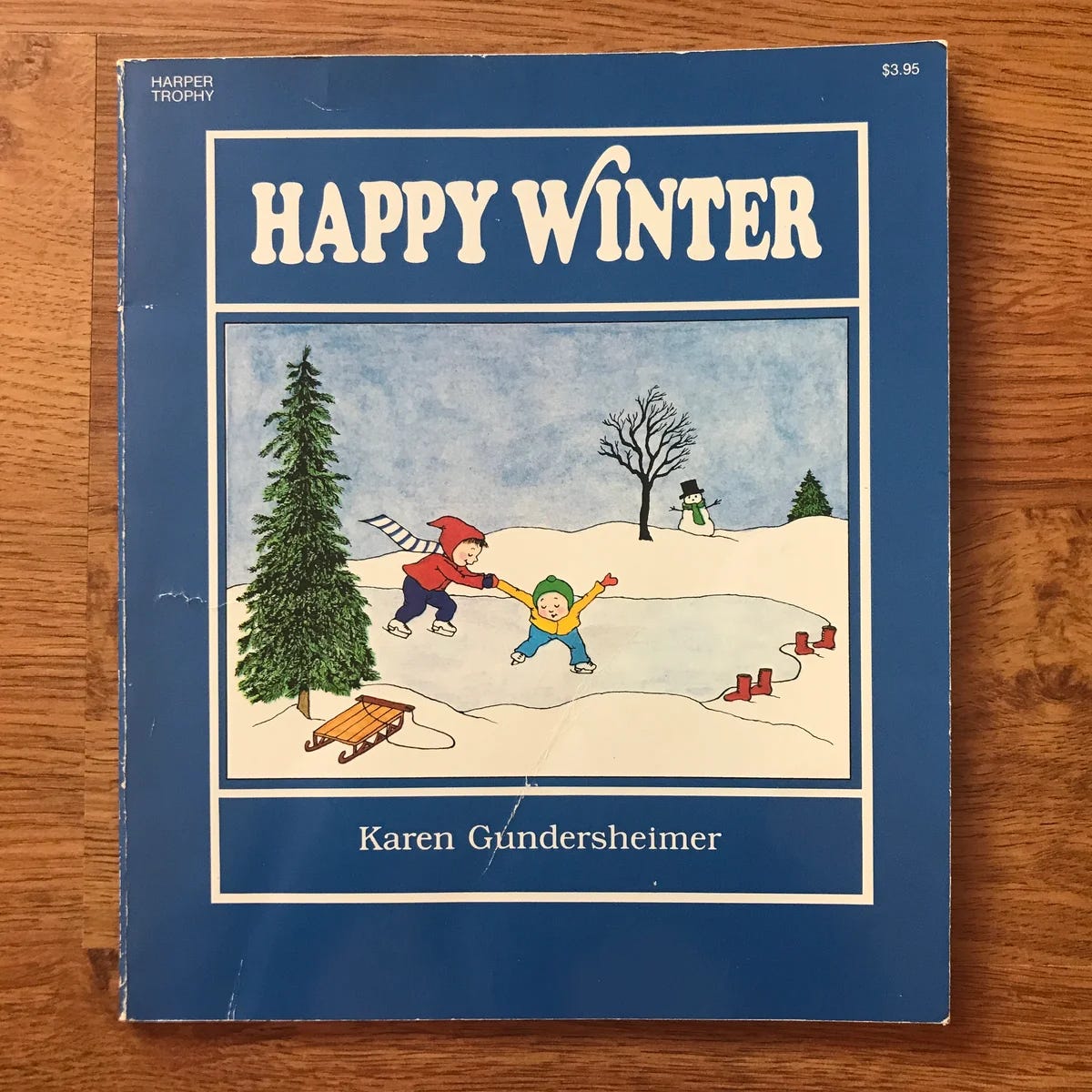
Karen Gundersheimer’s Happy Winter (1982, sadly out of print) is a book for that stretch. It’s not about Christmas or any holiday, though a Christmas tree is seen. it’s about what winter consists of when you’re not celebrating anything in particular - the lengthy process of getting dressed to go outside, how much more time you spend indoors, the baking, the reading, baths, dark that comes early and stays late.
A Day That Holds a Season
The structure is simple - though there’s a table of contents breaking down the sections of a day, the book is also made to be read in one go. The book moves from Morning to Night - breakfast, getting dressed, going outside, playing outside, coming inside, indoor activities, reading, bath, bed. It’s one day, though it also could just as easily be many days. The activities are one’s you do throughout the whole season, what you do again and again in the cold months. That day becomes the whole winter.

I wrote about Gundersheimer once before, when I discussed her illustrations for Jane Feder’s Beany. There, her drawings had a lovely selectivity - rarely did you see the whole room, mostly just boy and cat together, only the most relevant parts of memory depicted. Happy Winter was Gundersheimer’s debut as an author, as well as illustrator, and we see more of her world here, this time a more rural one: the full living room with its yellow curtains and toys scattered about, the kitchen with butter and sugar and mixing bowl, the view through the window of bare trees in the snow.
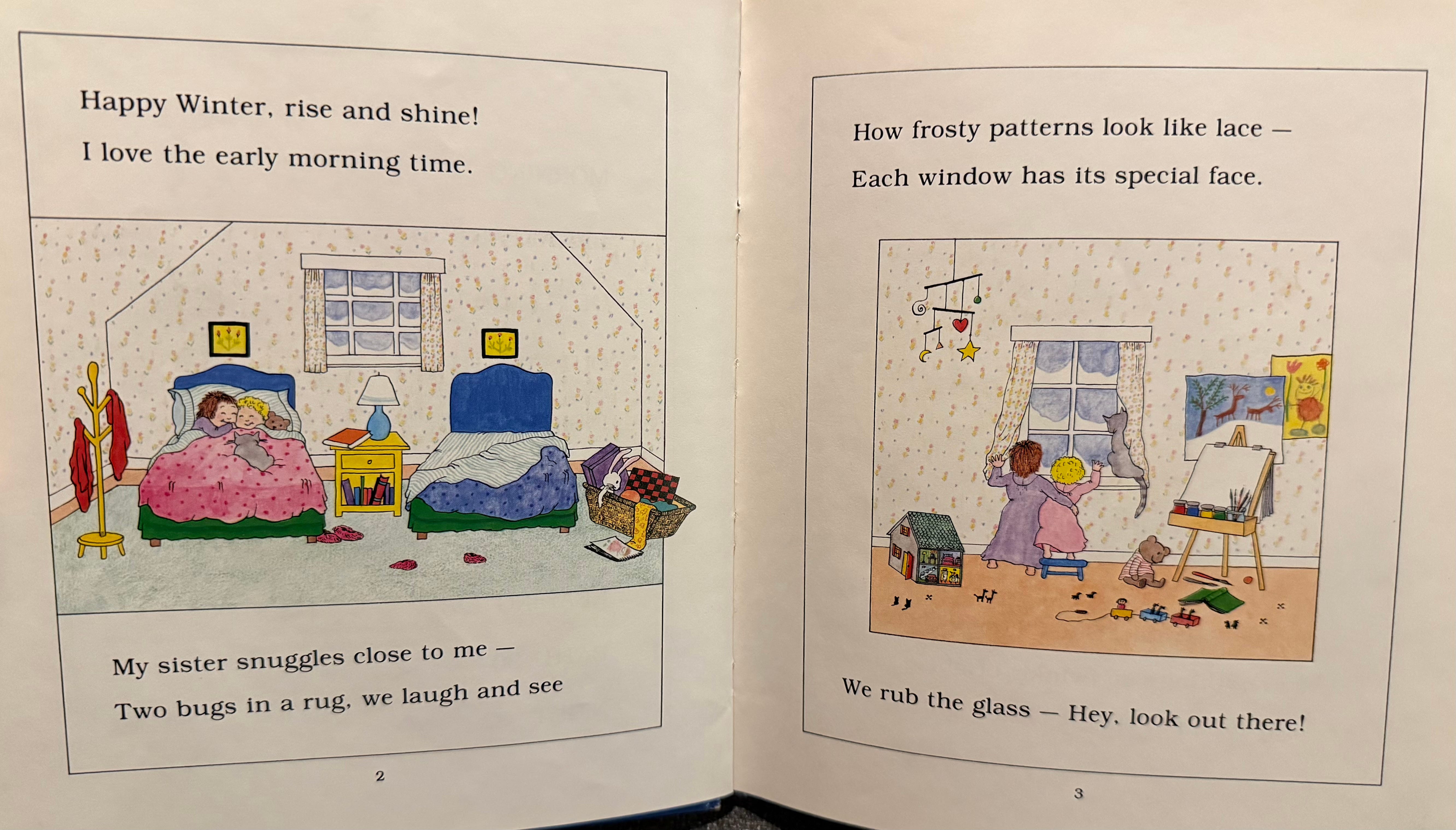
The style is the same - that soft, hand-drawn, warm, domestic interior - but this time with a larger frame. And where Beany was about a boy and his cat (the parents were present, though unimportant), Happy Winter shows more of a community. Friends appear, the sisters play hide-and-seek, . The mother comes for one last hug at bedtime. And, of course, a cat is still there, weaving through nearly every page (though NOT in the snow), but as part of the household.
The most different part of Happy Winter, however, is the text. This time, written by Gundersheimer herself, it’s completely in rhyming verse. It’s fun, it scans, it has the repeating “Happy winter!” for each section to place you in the parts of the day. The rhythm carries you through the day, the season, and ends in a lullaby. It’s lovely.
Baking For the Cold

This is the second book I’m writing about with a recipe, and it’s another chocolate cake, but this is a fudge cake, no thunder required. It’s a real recipe - tube (or Bundt) pan, melted chocolate, yogurt, etc. The book doesn’t just describe the baking, it works the reader into the process, and invites you to do so in your own home as well.
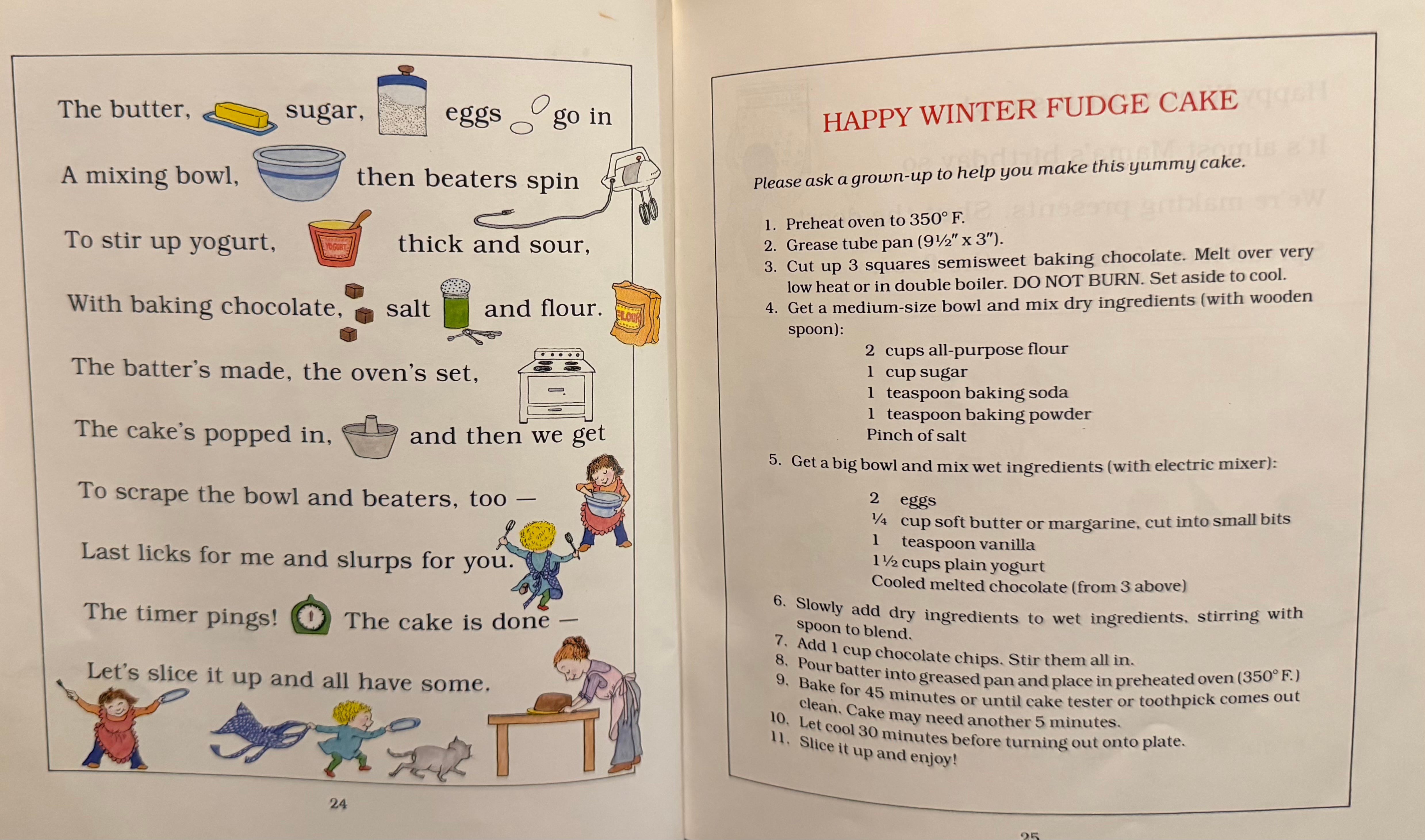
We're going to make it this week, my daughter and I. She's a little young to do much beyond watching and perhaps stirring, but she can be present for it - the way the children in the illustrations are present, watching the beaters spin, waiting for the timer to ping, licking a spoon. Baking in winter is its own kind of warmth. The oven heats the kitchen, the smell fills the house. You make something sweet against the cold.
Making Presents
One detail I also love when reading it now, that the “making presents” section isn’t about Christmas - the two girls are making and wrapping a gift for their mother’s December birthday. Winter is front-loaded with holidays, but contains these ordinary occasions that can get lost (sorry to all those December/early January birthdays out there). Birthdays still fall during the cold months, along with other reasons to make things for people you love.
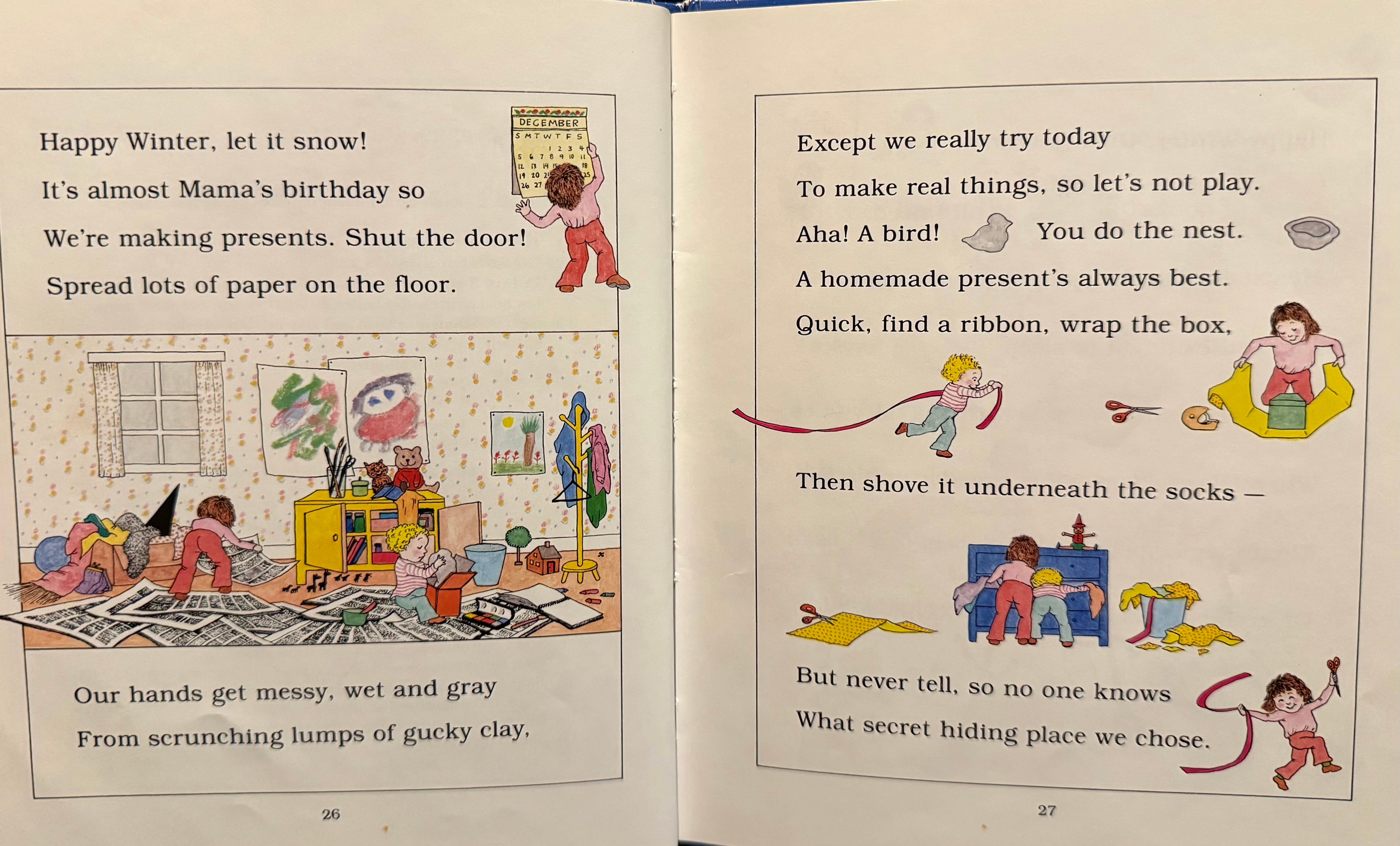
After a month of writing about Christmas books, about tradition and assimilation and resistance and spectacle, it’s nice to have a part about gifts that’s not just linked with Christmas, but rather with the reason we give gifts in general. Not about just what we celebrate in early winter, but about what we do throughout. Get dressed. Go outside, Come in. Bake something. Read. Get warm. Sleep.
The Darkness of Winter Nights
The final section marks a drastic shift, and it might be my favorite section still. After so many white pages and bright interiors, the last four pages go deep blue - a textured darkness that fills both spreads. No more illustrations here, just the warm dark and the words.
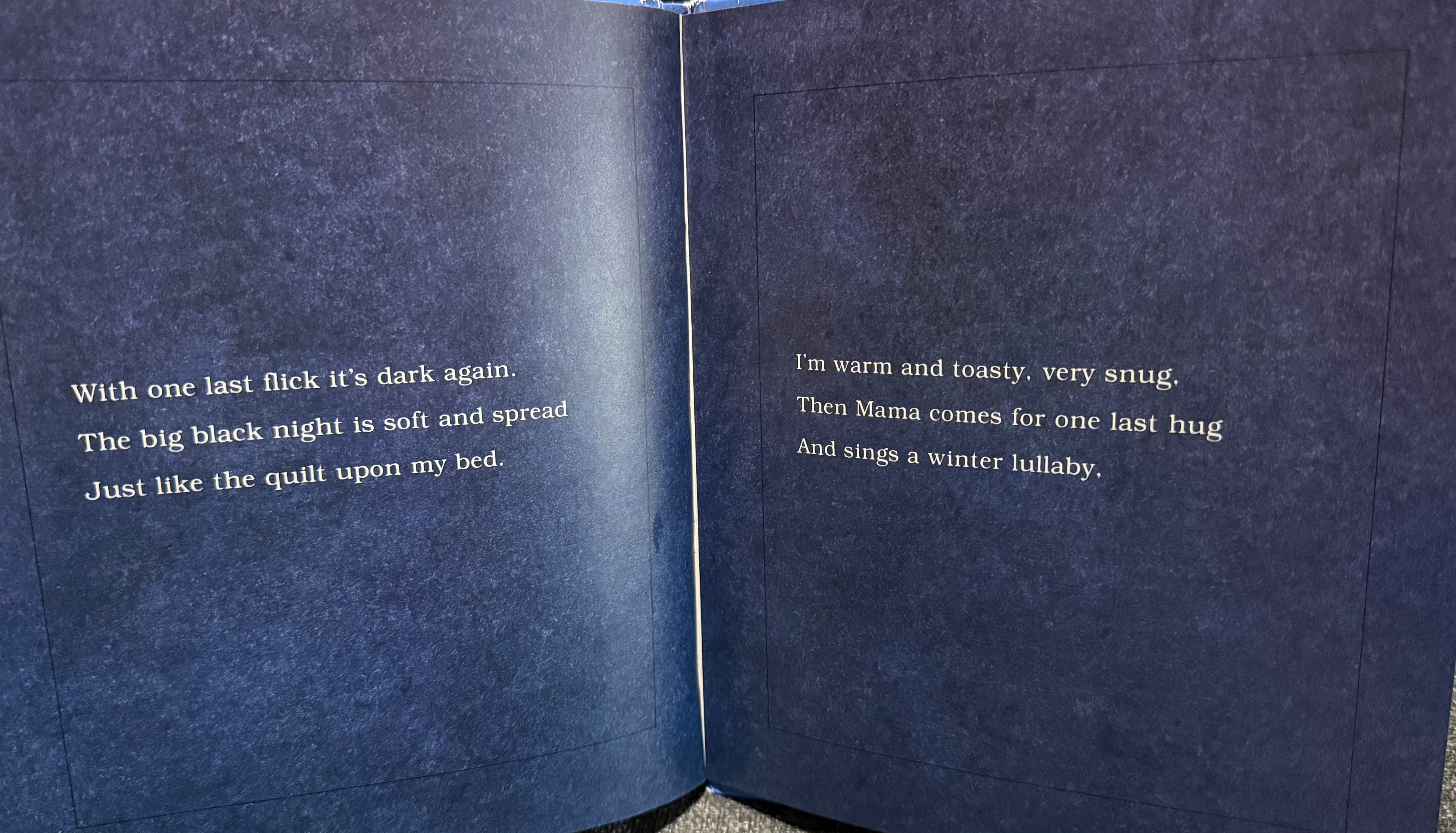
The visual darkness becomes comfort. “The big black night is soft and spread / Just like the quilt upon my bed” - night as blanket, darkness as warmth. You don’t see the child; you feel the coziness by implication. After a book full of activity and color, the ending is rest.
It’s a visual representation of January. The early dark that settles in by late afternoon. The retreat indoors, the snugness against the cold. Not bleak, but quiet. The day ends; winter continues; we’re warm inside.
What We Need From January
The Snowman ends with a kind of loss, the boy staring at his melted snowman. Happy Winter ends with rest - the children snug in bed, the warm dark soft like a quilt, a lullaby. Both of these are feelings of winter, containing impermanence and comfort alike. Containing solitude and the warmth of company.
My toddler hasn’t really figured out the bleak aspect of midwinter yet, that post-holiday stretch that requires its own type of endurance. For her, the idea of Christmas ending hasn’t hit. I expect some angst when we have to take down our tree and other decorations this weekend. For her right now, winter consists of Christmas books and Christmas lights and snow and the endless fascination of the process of putting on boots and the constant search for mittens. Happy Winter meets her where she is.
But it meets me where I am too. The book doesn’t promise a magical winter, but it does give an image of winter as survivable, even good, if you fill it with the right things: warmth, company, fudge cake, books, the soft dark at the end of the day. That’s enough for me, for my winter season.
I’m off now to make the fudge cake with my toddler. We’ll report back.