
The Fox, The Hen, and The Comedy of Errors
How Pictures Tell the Real Story in "Rosie's Walk"

“Rosie the hen went for a walk, across the yard, around the pond, over the haycock, past the mill, through the fence, under the beehives, and got back in time for dinner.”
That’s it. That’s the entire text of Pat Hutchins’ 1968 classic Rosie’s Walk. You’ve read it all now. Thirty-two words that describe the most oblivious protagonist (it would be a chicken) in children’s literature, taking a pleasant stroll around the farmyard. But anyone who has read this book knows that those thirty-two words tell only half the story - and arguably the less interesting half.
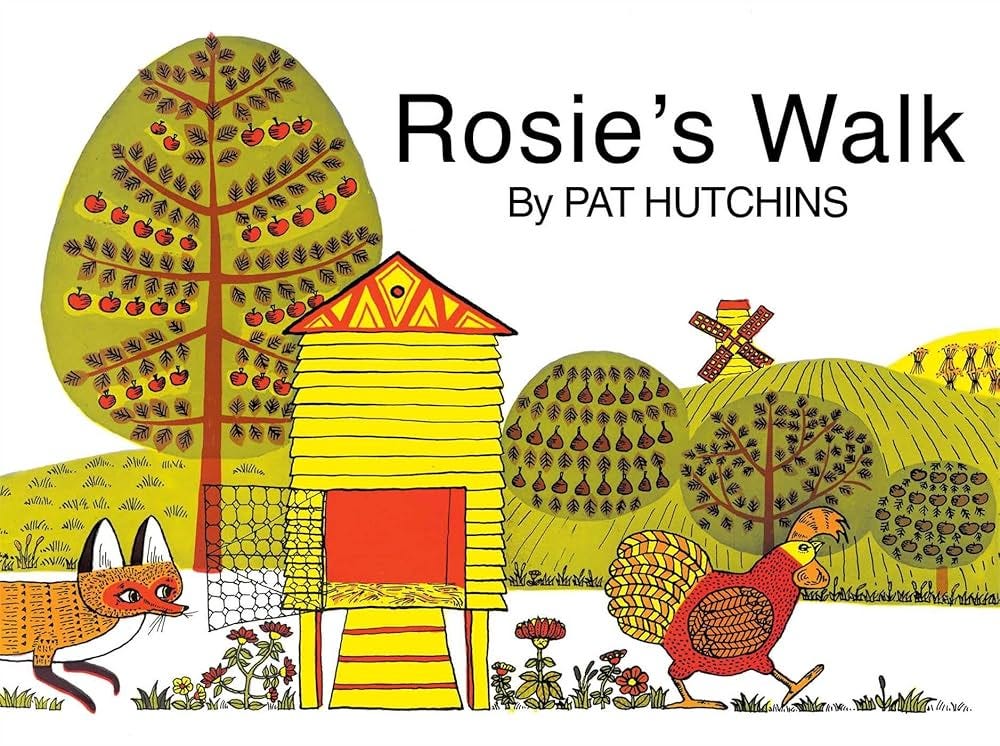
The real narrative unfolds entirely in Hutchins’ folk-art like illustrations, where an unnamed hapless fox stalks Rosie through her walk, suffering one spectacular mishap after another. He steps on a rake that smacks him in the face, falls into the pond, gets buried under hay, crashes into a beehive, and finally flees, pursued by a cloud of angry bees. Meanwhile, Rosie has a lovely walk, remaining serenely unaware of both her pursuer and his mounting disasters, arriving home in time for dinner exactly as promised.
The Untold Story
Rosie’s Walk is a perfect demonstration of what makes picture books unique as a storytelling medium. The text tells us about a peaceful country walk; the pictures reveal a slapstick comedy worthy of Buster Keaton. Neither story would work without the other. The fox’s mishaps are funnier because Rosie doesn’t notice them, and Rosie’s obliviousness is more charming because we can see what she’s missing.
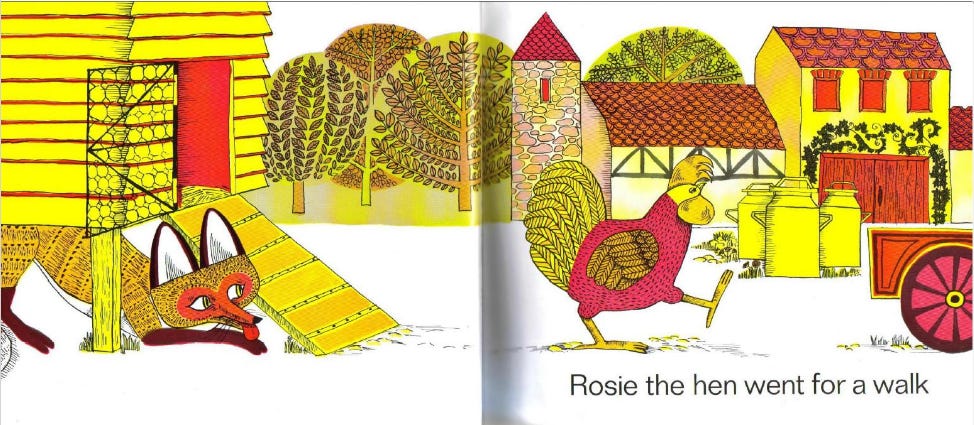
This dual narrative works brilliantly for multiple reading levels. Toddlers delight in spotting the fox on each page and anticipating his next calamity - my own toddler fills in her own sound effects for each mishap and loves to call out warnings like “he’s going to get hit with the rake!” They quickly learn to “read” the visual cues - the precarious placement of the rake, the weak board over the pond, the unstable haycock. Meanwhile, older readers can appreciate the sophisticated interplay between what the text claims is happening and what the pictures reveal actually happening, as well as the intricate art.
The Art of Comic Timing
Hutchins’ illustrations demonstrate impeccable understanding of visual comedy. Each page turn becomes a comedic beat, with the fox’s expressions growing increasingly frazzled while Rosie maintains her serene, head-high posture. The farmyard setting provides endless opportunities for physical comedy - every element from fence posts to flour sacks becomes a potential prop in the fox’s downfall.


Working within the printing limitations of the late 1960s - using only red, yellow, green, and black - Hutchins created her distinctive bold style with magic markers and felt-tip pens, then adding black ink outlines. This technique gives the illustrations their clean, graphic quality that reads clearly even to the youngest viewers. As Hutchins noted in one interview, “even the smallest child can read it. Even if they’re not quite there with the letters yet, they’ll understand the book, and more importantly, they can remember it.”
The Power of Restraint
What makes Rosie’s Walk so enduring is what it doesn’t do. Hutchins never explains the joke, never has Rosie acknowledge the fox, never lets the text intrude on the visual story. The fox appears in the pictures but never in the words. This restraint requires enormous confidence from both author and reader - confidence that children can read pictures as fluently as they read text.
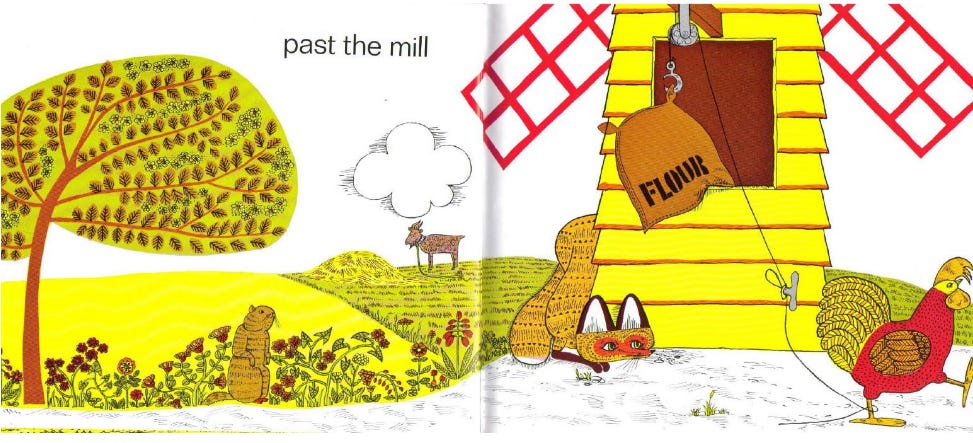
The book trusts young readers to understand some fairly sophisticated concepts about perspective and dramatic irony. We know something Rosie doesn’t know, and that knowledge makes us complicit in the storytelling. Children become active participants, not passive recipients of a pre-digested narrative.
Timeless Appeal
Nearly sixty years after publication, Rosie’s Walk remains as fresh and funny as ever. Its wordless visual comedy translates across cultures and generations. The basic setup - predator and prey, with the predator as bumbling comic relief - taps into something fundamental about how we understand stories and humor.
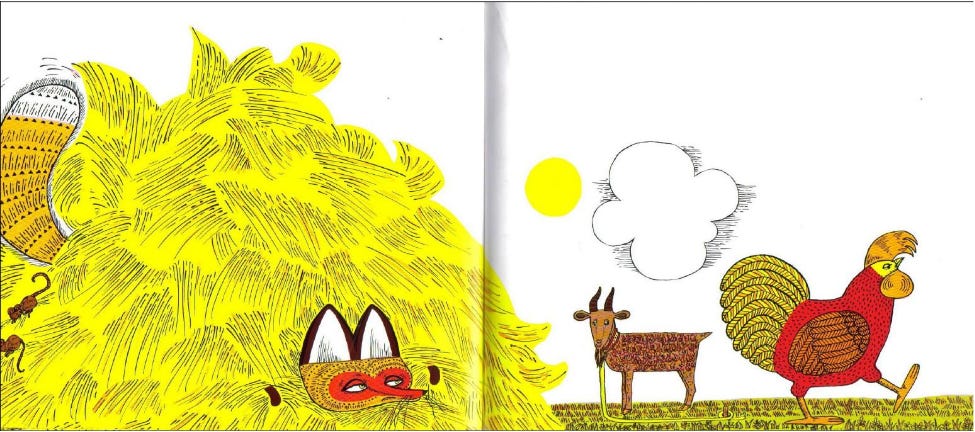
The book also serves as a gentle introduction to the concept that there can be multiple perspectives on the same events. Rosie experiences a pleasant walk; the fox experiences a series of disasters; readers experience a comedy. All three experiences are simultaneously true.
Rosie’s Walk shows us that sometimes the best storytelling happens in the spaces between words and pictures, where readers must actively participate in creating meaning. In those spaces, Pat Hutchins created something that feels both simple and sophisticated, timeless and immediate - a delightful book that reminds us why some of the most memorable stories are the ones where half the narrative lives in the art.
When I bought Rosie’s Walk at a bookstore recently, the millennial clerk looked at it and said wonderingly, “I remember this.” That kind of instant recognition speaks to the book’s enduring power - it lodges itself in visual memory in a way that purely text-based stories rarely do.
Edit: My mother would like me to add the Weston Woods animated version of Rosie’s Walk here:
Next up: Cynthia Rylant’s “When I Was Young in the Mountains” - a memoir in picture book form that captures childhood through sensory memory and shows us why sometimes staying put is enough.